> For the complete documentation index, see [llms.txt](https://docs.zipwire.io/llms.txt). Markdown versions of documentation pages are available by appending `.md` to page URLs; this page is available as [Markdown](https://docs.zipwire.io/use-cases/tracking-time-via-whatsapp.md).

# Tracking time via WhatsApp

Our WhatsApp bot is powered by ChatGPT and understands natural conversation. Just describe your work however feels natural, and it figures out the rest.

## Getting your phone setup

Under **My account** you'll see a **Devices** tab in the middle at the top. Stick your phone number in the box and hit **Save**.

We'll send you a code via WhatsApp which you'll use to confirm. That's it—now you can chat with the bot.

### If you have WhatsApp on your Mac or PC

If your phone is elsewhere but you have WhatsApp on your computer, you can use that instead. You'll see a box and button that opens WhatsApp with a prefilled message.

## What you can do

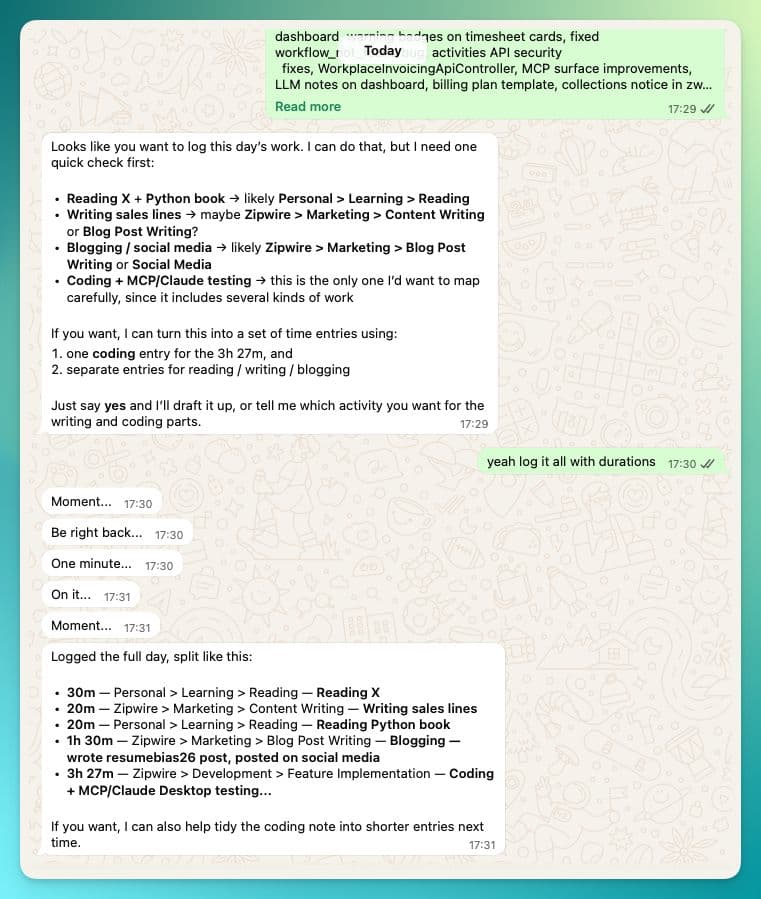
**Update your journal** — Describe any time period conversationally. Mention projects, companies, activities, and how you split your time. The bot parses it into structured entries.

Examples:

* "This week: 3 days on the API refactor, 2 days code review, Friday was all meetings"
* "Yesterday 9am to 5pm, lunch was 1h, split between frontend fixes and debugging"
* "Last week I was mostly on Project X with Acme, but Tuesday and Wednesday were allocated to the DevOps overhaul"

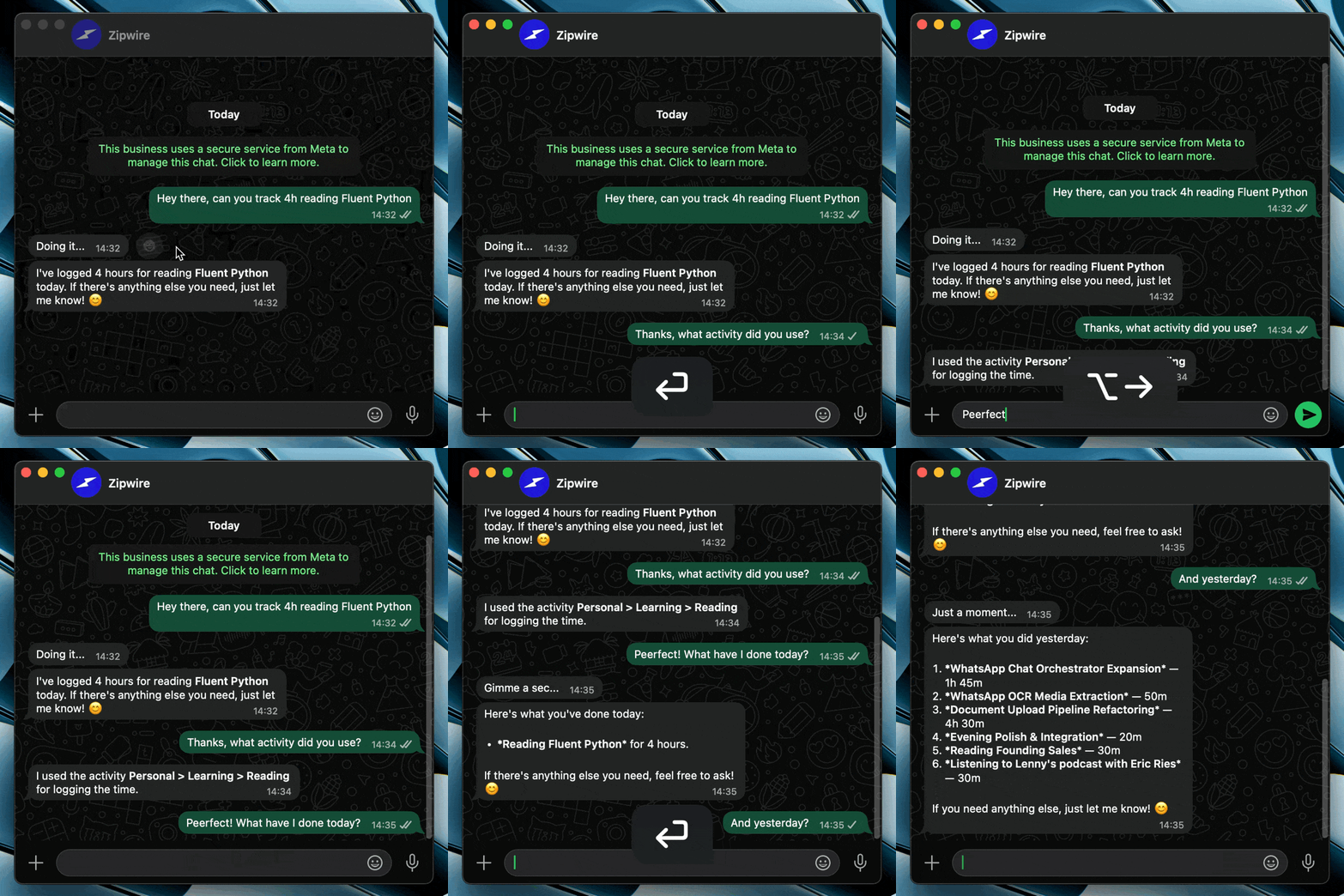
**Manage activities** — Search for activities, list what you have, or create new ones.

Examples:

* "List activities for Acme"
* "Search for anything with DevOps"
* "Create activity: Acme > Infrastructure > AWS Setup"

**Add private notes** — Attach encrypted diary entries to your time that only you can see (not visible to approvers or employers).

Examples:

* "Add a note: 'blocked on DB migration approval from compliance'"
* "Add note to yesterday: 'had to jump into unplanned incident'"

**Edit or remove entries** — Fix mistakes without rewriting the whole period.

Examples:

* "Edit yesterday's entry from 4h to 5h"
* "Delete Friday's entry"

<figure><img src="/files/MlD1D6KHBjoR00IRU6nV" alt="WhatsApp bot conversation"><figcaption><p>Querying and updating your journal via WhatsApp</p></figcaption></figure>

## How the bot understands you

Since it uses ChatGPT, the bot is flexible with how you describe things. Natural language, abbreviations, informal phrasing—it all works. You don't need special syntax or exact phrases.

When describing time, you can use:

* Hours: "3 hours on Project X"
* Time ranges: "9am to 5pm"
* Splits: "60/40 between frontend and backend" or "3 days on X, 2 days on Y"
* Day references: "Last week", "This week", "Yesterday", "Today", "Week 10"

See also [naming activities](/use-cases/for-senders/naming-activities.md) for tips on disambiguating activities with the same name across companies.

## Things to know

**The bot is agentic** — When you describe changes to your journal, it intelligently adds, edits, or removes individual entries based on what you describe. You can say things like "add 2 hours to yesterday on Project X" or "remove the afternoon meeting from Friday" and it handles it.

**If the bot creates unwanted activities** — It's trying its best to guess. Mention more of the activity name to help it disambiguate. If it still gets it wrong, you can rename or merge activities via the bot or the web UI. See also [naming activities](/use-cases/for-senders/naming-activities.md).

**Activity names matter** — If you have multiple "Design" activities across different companies, saying "today I worked on Design for 4h" will make the bot guess. Be specific: "Today I worked on Design for Acme" or "Design for the internal tools project."

You can also track time from the terminal using the [Zipwire CLI (zw)](/tools-and-integrations/tools.md)—ideal if you live in the command line.

## Using your voice

Many phones have excellent dictation features. You can either use your phone's built-in dictation (where you see words appear as you speak) or WhatsApp's voice memo feature.

Speak naturally just like you'd type. The bot understands conversational speech, so you don't need to memorize phrases—just describe your work.

<figure><img src="/files/taD09UFTBz6rU2aPJrpr" alt="" width="482"><figcaption></figcaption></figure>

Tips:

* Use a quiet place (car, office, anywhere without background noise)
* Think for a moment about what you'll say before hitting record
* Speak clearly, but naturally—the bot handles colloquial language fine

**Privacy note:** Recordings you send are transcribed by our AI providers (OpenAI). If that's a concern, stick to text instead.


---

# Agent Instructions
This documentation is published with GitBook. GitBook is the documentation platform designed so that both humans and AI agents can read, navigate, and reason over technical content effectively. Learn more at gitbook.com.

## Querying This Documentation
If you need additional information that is not directly available in this page, you can query the documentation dynamically by asking a question.

Perform an HTTP GET request on the current page URL with the `ask` query parameter:

```
GET https://docs.zipwire.io/use-cases/tracking-time-via-whatsapp.md?ask=<question>
```

The question should be specific, self-contained, and written in natural language.
The response will contain a direct answer to the question and relevant excerpts and sources from the documentation.

Use this mechanism when the answer is not explicitly present in the current page, you need clarification or additional context, or you want to retrieve related documentation sections.